Trap music is on fire lately, so naturally everyone wants to make it.
Elements of Trap Music:
1. Roland TR808 kicks, hats, toms and snares
Kicks are made to sustain for a long time typically to emphasize sub bass tails. 808 Toms are probably the most common element used for “fills” (maybe every 4 bars or so, depending on energy of the tune and what else in it).
Typically the snare is an 808 snare with an equalizer boost around 200hz and highpassed somewhere in the 50-120hz range (depending on the bass of course!)
You can obtain these from any 808 sample pack on the net, use an actual TR808 or Nepheton by D16 Software which emulates a TR808 in a VST (I happen to use Nepheton myself).
2. Drip effects
Sampled or synthesized water droplet sounds are very common.
3. Chants
Made popular in recent history by Crunk artists like Lil’ Jon and the Eastside Boyz. Sounds a bit like old native american chants (think of the classic Ho-Ya Ho-Ya Ho-Ya Ho-Ya war / drum circle chant used in a lot of movies). But in crunk, it’s “Hey!…Hey!…Hey!…Hey!”, or “Grr” “Uh-huh” or any other type of repetitive short vocal hit. You can cut these from rap acapellas a lot of the time.
4. Leads, other basses etc
This is the best part about trapstyle – the rest is pretty much up to you! A lot of artists will put moombahton leads hits and elements to fill the lead line, or some will play something dubsteppy to give it a melody, or even electro or swing elements go well in here. Another alternative that is fairly common is to do literally NOTHING in this place, instead putting in a raw lead vocal acapella or emphasizing variations of the standard elements of trap in the beat. It really is up to you… And I think this is what motivates a lot of artists like myself to make this type of music. You are left with a lot to your imagination as to what goes in (at this point in time, anyway!)
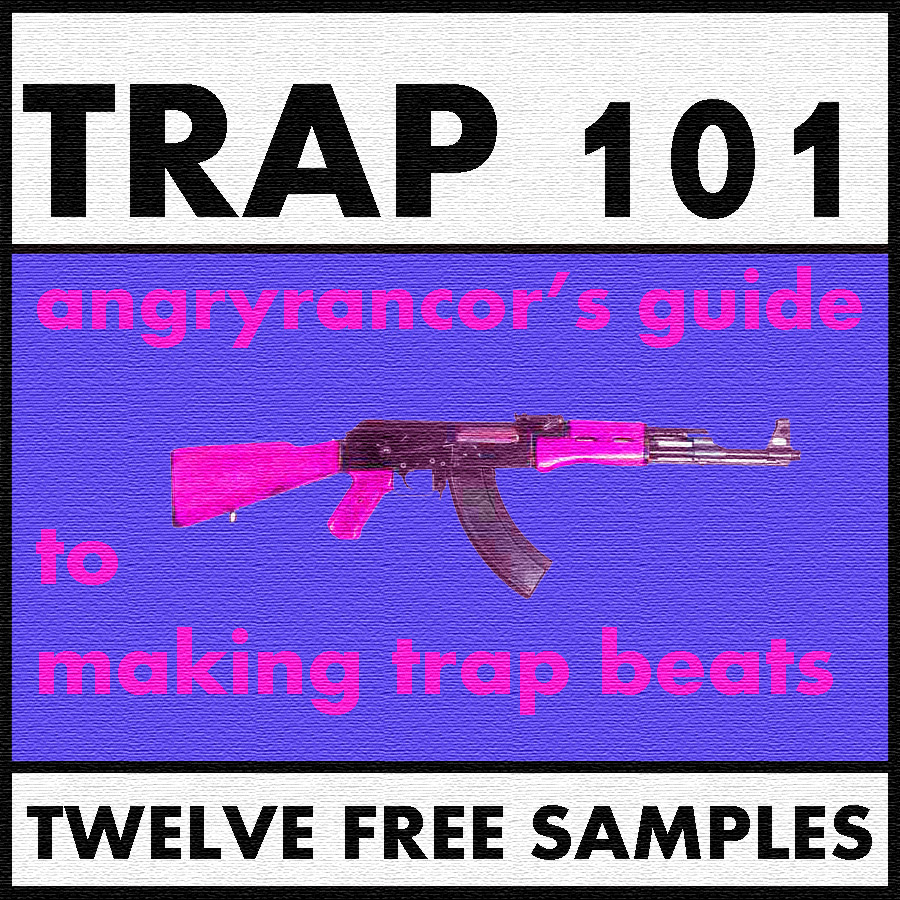
I attached a sample pack of loops made in Nepheton (a TR808 emulator VST). Feel free to cut out the individual drums or use the loops in your own compositions, however you see fit.
Have fun with em, I reserve no rights except to ask that if you redistribute the raw loop files let everyone know they came from angryrancor and bassadelic.com. Otherwise go ahead and use them in your own free or for sale music – you can give a mention to me and bassadelic on your tunes if you want, but it isn’t required.
Here are a few trap tunes I’ve made:
Again, in case ya missed it, here’s the free sample pack for ya!
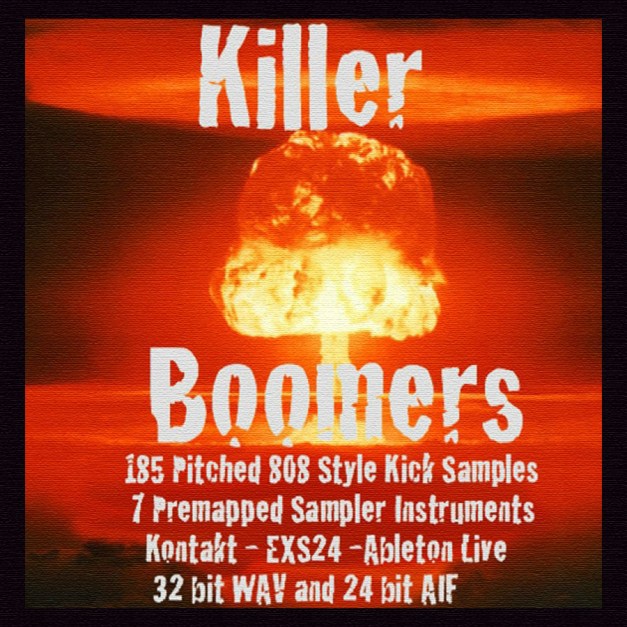
So my homie Simteks just came out with a new package for edm producers, and it’s dope! He’s selling it for only a few bucks, and you’re definitely going to want to check it out… here’s a preview:
Here’s the write-up, in Simtek’s own words….
This sample pack contains:
185 x 32 bit .wav files
185 x 24 bit .aif files
7 x sampler instruments
FORMATS
Ableton Live, Kontakt, EXS24
A sample pack containing 185 high quality files of seven different kicks, multisampled and covering bass notes down from C2. There are at least two octaves worth of samples for seven different styles of kick, all inspired by the classic Roland TR-808 boom. These samples have been meticulously synthesized and processed, and are recorded with plenty of headroom so you can gel them in whatever mix you would like to put them in. Each different kick features different tail lengths, harmonics and dynamic behavior so you can pick just the right kick for your track. There are also seven sampler instruments premapped for Live, Kontakt, and Logic users out there, for easy plug and play usage.
Why not just get an 808 sample and pitch it, you ask?
Depending on the quality of the sample, pitching an 808 sample can sound pretty terrible. Some are low bitrate, and do not transpose well, some have tape distortion or some other analog effect applied and when pitched sound off. Sometimes, you just want a short tail, and pitching samples up results in an unuseably short kick; while pitching them down results in distortion and a longer tail that you desire. This pack contains one sample for EVERY note at least two octaves below C2, so sample stretching is no longer necessary.
____________________________________________________________________________
Thanks for the awesome samples, Simteks! They’re dope as hell, and I’m starting to see more people download them and talk ’em up :)
So, every so often, the term ‘purple’ gets thrown into music. What does it mean? What is this ‘purple’ thing about? There’s a few different styles that have incorporated the ‘purple,’ sound or mindset, and I’ll do my best to explain them to you…
Purple used to be associated as sort of a ‘royal’ color, but there are lots of uses of purple in history… For a lot of people, consciously or subconsciously, it’s a color of mystery. Prince wore a lot of purple. Hendrix wore a lot of purple. It’s an intriguing color, and some of the musicians of the last fifty years to wear it seem to have a certain exciting intrigue to them… Is it because they’re wearing purple, or because their mysterious persona gravitates towards it? I would guess it’s not the former – because if it were, that would be a prime example of faking the funk, as funk goes right along with making purple. I’ll get into that a little later.
Let’s discuss the music aspect of it. Though I did mention Jimi Hendrix, for the purposes of this article, I would instead like to point out specific styles or genres that incorporate purple, rather than individual musicians, and I think there are three main instances of ‘purple’ sounds in modern music (especially electronic music) of the last few decades –
1.) funk / ‘old-style’ electro
2.) hip hop (especially chopped ‘n screwed)
3.) wonky purple edm
Alright. So first let’s address the funky electro…
Well, basically, you can find a lot of this stuff coming from the very late 70s, and up until the early or mid 80s. It’s synthy as hell, and often employs the use of vocoders and talkboxes.
Purple is a swagger, it’s an attitude, and a lot of this music has a big dose of funk smeared all over it – and funk is an attitude and swagger as well. So, at first, you might guess there is an overlap, but in fact, I would make the argument that purple comes right out of funk. It might be seen as a subgenre, but really I think what creates the purple funk, more than anything else, is having a confident and funky outlook on things, which could, in turn, lead to a purple demeanor. Confused yet? Well, it’s not so easy making purple music, is it? Don’t worry, I’ll explain it some more. But first here’s a great example of some old electro funk, to keep you going…
The second instance of purple I want to talk about comes ten years later, in hip hop. Before I go any further, though, I should point out that a lot of hip hop in the early 80s was married to electro funk. It makes sense when you consider that hip hop, as well as purple, come right out of funk (funk spreads its seeds all over the place). That being said, hip hop in the 90s sounded quite a bit different than most of the electro funk of the 80s – especially the chopped ‘n screwed hip hop from Houston, Texas.
So, when you hear talk of purple, in reference to chopped ‘n screwed, people are usually referring to codeine / syrup / ‘lean’ / purple drank, etc; and also to chopped ‘n’ screwed music, which is kind of like a soundtrack for purple drank. It’s a sound created by DJ Screw, a DJ from Texas who made TONS of rap mixes with a heavy, heavy purple influence… Anyone who’s drank lean and then listened to DJ Screw will likely agree with me on that… The music is so slow that it’s almost scary. It really has one of the most unique sounds of any genre or subgenre I’ve ever heard, and I’ve heard a great deal of music in my time. Here’s an example, if you’re not familar…
Ok, so, the third instance of purple takes place in more modern times, and in edm/rave music. Actually, I’d like to point out an article I read about ‘purple-wow,’ a phrase which I’ve never heard anyone use in real life, but just the same, it’s a relevant article, and yo might want to check it out here: http://generationbass.com/2009/08/17/the-purple-wow-sound-g-funk-meets-dubstep/ Their definition of this sounds is, basically, “G-Funk meets Dubstep = Purple Wow Sound!” .. personally, I think you can easily go beyond dubstep with it, and also, “Purple Wow,” is a really cumbersome and wonky name for anything.. And also, I think something’s to be said for the wonkiness of the sound.. I think it has a lot to do with making funky music, with it’s unique style of wonky / off / almost dissonant melody.
For example, if you start playing a melody (and wonky melodies often employ the use of square waves, btw) people might think your melody is going in a certain direction – but then, all of a sudden, one of the notes just rises an extra octave or two, and the next note clashes! Then the melody goes back to normal, then it drops an extra octave or two, just for a note, and then raises up in pitch to normal, and repeats that cycle, over and over. That’s just one of a few ways to incorporate a wonky / purple melody. Killing the expectation goes along way here, musically. You can really create a wonky off-type of sound by leading people on and then going in a decidedly different, weirder direction. Sometimes it even sounds ugly. This also goes along with funk. ‘Funk’ was originally a term used to describe jazz music, as in, ‘smear some funk on that melody,’ etc.
Exactly! Smear some nasty, funky purple all over your melody!
Also, don’t forget about the rhythm. I know I’ve mentioned this before, and one of my very first video tutorials was about it. Wonky / off-beat rhythms have gone into a lot of interesting songs that hail the label of ‘purple’ as their weird and funky flag. I like artists such as Joker, Ginz, some Joy Orbison, and the tune, ‘Drippin’ by Mimosa is also pretty purple and crunky.
(I have also seen the term, ‘wonky’ used to describe specific techno and trance tracks, like the one by Paul Van Dyke or whomever… the track is called ‘wonky,’ and I think it basically just means high-pitched or ugly, or something like that. I hate what techno has tried to do with wonky, it’s boring, and they use the term in the blandest and most boring ways imaginable, and I refuse to write about it anymore than I am right now.)
Anyway, here’s a good wonky purple tune for ya, from Joker…
So, in conclusion, incorporating elements from any of these styles can help you create a nice, funky, purplish sound. There’s obviously overlap, stylistically, as you could go right ahead and create a chopped ‘n screwed type of wonky beat, with vocodor and electro funk influences, if you wanted to. No reason to stifle yourself creatively, when going for the purple! Another example of overlap could be how you might see the word ‘crunk’ a lot more in electronic music now, even though that style came directly out of from hip hop.
So, as far as the last few decades of purple go, there’s the purple electro funkishness, the purple drank chopped ‘n screwed stuff, and the modern ravey dubstep or post-dubstep square wave / wonky funk stuff, which often incorporates the hip hop and electro funk stuff, too. Really, any of the influences I described can be taken and smeared in any direction you might want to take them. If you find yourself gravitating towards purple, perhaps you’re in a good position to purple-up some new styles of funk that the world hasn’t even heard, yet! I’d be down to listen to some new purple, any damn day.
So, we’ve all seen it… on tv shows, on popular blogs, or hearing from a friend of a friend of a friend, that, “Oh yea, what’s-his-name posted a video, and it went fucking viral! Four million people saw that video, and now he’s got… like… a career, or whatever, making videos, you know? Word!”
I remember how, on so many tv shows, they would have an ‘internet-themed’ episode, where some character does something stupid, and posts it on youtube, and then – BAM! – instant success, instant fame, and now they have to pick up the pieces of dealing with stardom. Ten thousand billion-trillion hits (and counting) on their little video.
It’s typically a bunch of bullshit, and here’s why…
You’re probably not going to have anything you do ‘go viral,’ for a long time. But actually, before I get on to that, let’s back up a second, and allow me to explain something… What is Viral, really?
Here’s a little blurb from Wikipedia…
“The adjective or adverb viral and the noun virality may refer to any viral phenomenon, that is, an object or pattern that is able to induce some agents to replicate it, resulting in many copies being produced and spread around. For example, virality relating to social, cultural, emotional and affective contagions that spread through sociotechnical networks.”
So, if you post an image to Facebook of a sad clown tripping over a cute kitten, and someone shares the image to Tumblr, and someone shares that to Twitter, and Anderson Cooper sees it and posts it on CNN, that’s ‘viral,’ right? Or, at least, that’s the idea, right?
Here’s the thing. You’re probably on this site because you want to make music, don’t you? So how do you make your first album go viral? Chances are, it won’t.
Let me repeat that, it won’t.
There’s this myth out there, that everyone knows about (but few talk about it as being a myth) that basically makes people believe they can achieve instant stardom with very little work. All you have to do is ‘get lucky,’ eh? Yes, it’s happened, I know, but let’s get realistic for a second… Most of the ‘reality-stars’ don’t really go very far, do they? I mean, some of them get their fifteen minutes of fame, but then what? Remember that ‘I Love New York,’ woman? Does anyone? Where is she now? She was trying to make a name for herself, but it sort of fizzled out, didn’t it?
If your goal is to ‘go viral,’ and have everyone see what you’re doing, wouldn’t it be better if you already had a ton of work done, and a lot of content to show for yourself? I mean, think about it, if you did have ‘that one awesome viral video,’ and it leads people back to your site, wouldn’t it be great if you had more than one or two tracks to show people?
If you had a whole album, or a whole string of albums, people would be more likely to buy them up and talk about you then if you just had one song that people could just listen to, over and over again, right?
Do you see what I’m saying, now? The whole ‘going viral’ thing isn’t a ‘bad’ thing, but it isn’t something you should really be hoping for if you don’t have much for people to virally link back to you for… and even if you don’t ‘go viral,’ right away (which you probably won’t) what is the big deal? If you put in hard work, and smart work, and good work, there’s a decent chance people will start to see it, eventually. I know that’s not the glorified myth that people want to hear. It’s not the instant-fame story people want to easily run into. It’s not a big bag of gold someone put on your front doorstep. But come on, which reality is that supposed to take place in, anyway?
Pretty much anyone who ‘goes viral,’ and then manages to stay afloat afterwards (and develop a career out of) probably had a good career prospect to begin with. Those who had nothing to offer tend to see their viral-careers die out pretty quickly.
There are, of course, a small number of exceptions – but those exceptions are broadcast over and over and over, as the media shoves them in your face as it screams at you, “Here, here it is – you can be popular like this stupid lucky person, isn’t it great?”
No, it’s a goddamn carrot on a goddamn string. They want you to think you could get lucky, so you’ll stay tuned through the next few commercials (and then buy deodorant or beer or whatever) and then watch the five-minute clip they have about the newest so-and-so internet start who “got lucky.”
You might say, “Wait a minute, people do get lucky! People win the lottery everyday!”
True, they do. Out of seven billion people, a few do get lucky. A few. Only a few. I never buy lottery tickets, and I think it’s just one more way to trick the poor into giving up their money, a couple dollars at a time… “Look at the fabulous winners!” No, I don’t want to, it’s a bunch of bullshit. That’s not how most people get wealthy or successful (you know else who also ‘gets lucky’…? The people selling the lottery tickets… just saying…)
Unless you have something to say and are willing to work hard and have something to show for it (or, simply put, unless you have something of ACTUAL quality) then you’re not REALLY going to get anywhere.
Though, on a positive note, it is worth pointing out that if you are working hard and willing to keep working hard and push out quality, then guess what? There’s a lot of folks in your field who ARE under the impression they can just do a minimal amount of work and then they’ll ‘go viral’ – and have that cash truck show up at their house, with a bunch of unicorns and mermaids and cupcakes, and they’ll all rejoice about how easy it is to strike it rich with all that internet-gold!
But they’re going to burn out, and burn out QUICK, because, sooner or later, they’ll realize that it just isn’t happening for them fast enough. Then, those with real ambition, like YOU, invariably get to the top a lot quicker. It’s basic math.
Timothy Ferris says there is not much competition at the top. I believe it. So, think big. But also, try to remember that most people will give up before they even get halfway up that damn mountain, once they understand how big the mountain is. It’s not easy, but it’s worth it. Most people, in my opinion, are extremely lazy. If you can motivate yourself to get past the point of someone else’s laziness, you’re on your way to becoming a lot more successful.
This is obviously an article for beginners. I’d like to give a little advice to those n00bs out there (because we all started out as n00bs, no shame in it) who dream of being the next StrangeFlow! …Ok, so that might not be your dream. Maybe you want to be the next Skrillex or Moby or some other famous musician? Ok, that’s also fine.
Anyway, the point is, your first track is probably going to suck. I could be wrong, it could be the craziest thing ever; but, unless you have a decent amount of experience in music – if you’re still new at it, then the first sound you make probably isn’t going to be that great. And, that’s fine! Even if you’re relying entirely on complex samples you didn’t alter whatsoever – well, then you’re just going to sound cookie cutter and boring, and that’s arguably even worse!
So, what’s the point of this article? Am I trying to discourage you? No, of course not! You should make that first shitty track and learn what you’re doing with it! My first few tracks were god-awful – and even if you’re first track isn’t terrible, you’ll still know it was your first track, later on, as you progress in skill and develop style.
A lot of folks over-plan everything for their first track, when, really, what they SHOULD be doing is figuring out where they’re going during the process of writing their first track. And yes, obviously, it’s never a bad idea to do your homework and figure out where you want to go, to a minor degree, but my basic point is this: you shouldn’t expect your first groove to be the best groove of your career. There’s a 99.9% chance it will NOT be your best. So, try out some things; figure out what you enjoy, and see what you might be good at. Gauge your potential.
Do NOT expect to put your very first track on your first album.
Now, this advice might prove wrong if your track turns out better than you thought, but don’t anticipate gold upon your first try. Don’t take two months on it, either. It’s not going to sound as epic and awesome as you thought it would. Plus, if you take too long, you’ll likely lose track of what your original ideas were, to begin with… Not that you should know EVERYTHING about the track beforehand, but just having a general idea is best. Remember that – a GENERAL idea.
Also, you shouldn’t take longer than a week to cut the track. Ideally, it should take less time than that. Seriously. I know your first song will probably be a big deal for you, and there’s nothing wrong with that – and, in fact, that’s great. It should be a big deal, this is your introduction into the wonderful world of music production! But you should consider your first track like a rough draft for some of your future tunes.
Remember, if your first jam really sucks, what’s the big deal? It’s your first tune, and at least you didn’t spend three months on it. Besides, you don’t need to show it to anybody, if you don’t want to. Though, you’ll probably be playing it non-stop for about a week. Again, nothing wrong with that, either; you should be proud that you were able to accomplish what most people don’t know how to do, and don’t have the patience to figure out.
I’m not saying you need to rush through every song you do, but trust me when I say this – you can plan things out much better (and go into crazy amounts of planning) once you know where you stand. Maybe you’ll start making an electro tune and it’ll come out as hip hop. Or, vice versa. That type of thing has happened to me, and it’s happened to most musicians who aren’t afraid to experiment a little bit.
Also, don’t get caught up in fake-professionalism, taking hours trying to figure out which is a better use of your time – the 808 snare or some jungle sample you stole from a Venetian Snares track. Make two tracks, one with each! Bing bang! Now you got two versions, the ‘real’ version, and the ‘alternative’ version!
Just get it done, and don’t spend three days tweaking some 6Blocc wobble patch in Massive! If you really want to do that, do it next time. I’ve heard so many new tracks by completely-new producers who go on rants about all the time they took on some minor preset (getting it just perfect, spending crazy amounts of time getting it juuuust right, etc) and then I’ll listen to their track, and the preset will be decent, but I’ll think, “goddamn, that’s a shitty beat… It’s not ambitious at all; he was going for a basic dubstep beat, and it’s mediocre and quantized incorrectly!”
If this helps, here’s an obtuse piece of advice that many will surely take offense to – all electronic music can be over-simplistically put into two camps, rhythmically: house, and hip hop.
Yes, it’s insane to say something like that, isn’t it? Electro has nothing to do with house, and there’s no hip hop in it at all, is there? Listen to the beat. Does it have that stomping boom….boom…boom…boom sound? It does, doesn’t it? Exactly. House.
With that last comment, I can expect at least a little bit of hate in the comments. Ha! But that’s Ok… If I can survive an onslaught of fickle readers when I release an article about Rolling Stone magazine falling out of relevancy, I can survive anger from a hip hop vs. house point of view ;)
Back to the point, why is it helpful to debate the hip hop vs. house thing in the first place? Well, it might help to know what direction you’re going into, as an artist, for one thing. If you really hate the house vs. hip hop thing, then go on making music without it – but all I’m saying is, if you’re going to make a certain style of music, it can’t hurt to know where your chosen genre stems from, so you can do some homework and figure out how best to make your particular style of music even better.
Example: So you want to make grime? Why the hell wouldn’t you want to listen to a ton of hip hop, then? British hip hop & rap, and American hip hop & rap.
So, there you have it… I don’t mean to come off as angry, I just wanted to express some basic points that I wish someone would’ve told me when I was beginning electronic music. Beginners still make these same classic mistakes, and it’s not the end of the world, but you’d think some n00bs would have better information about the whole thing – especially when you consider how many people are making edm these days. Ten years ago, everyone around me called my music techno, even though I was making weird / annoying hip hop remixes of big band tunes. But, eventually, my music got a whole lot better, and culture progressed a lot, too. Now, anyone who thinks electronic music is all just techno really just isn’t paying attention to music culture. Ah, but once again, as I always do, I’m digressing about music culture… The point I’m trying to make is this – your first track won’t be gold, and that’s Ok – just get it done, and then figure out what you want to do in music, and go for it! End of rant.
So I was wondering about how better to add value to this site for musicians, and I thought, well, why not get super specific about it?
It’s great to have how-to guides for genres, or tips on productivity and creativity (and, in fact, I like doing all those things, too, as I find articles like that quite helpful) but also, I decided it might be good to get into dissecting the real-world methods of actual musicians…
I decided to do a dissection of a song that I think it representative of (some of) the modern glitch hop / edm I’ve been hearing lately…
I mentioned in an earlier article how it can be good to sit through your favorite tracks and write down specific things about the track, to give you an in-depth idea about what you’re hearing… so, on that note, I decided to give an example of such an exercise.
One difference, though, is that this is an article, and not a series of bullet-points. I feel it will be better to write it in paragraph-format so that I can get into more detail on each point. I decided to go really in-depth on it, too, because I figured that would be the most helpful way to go about it…
Some of the techniques I mention might seem obvious, but I’ll try to mention them, anyway, because they could, potentially, be very helpful.
I dissected Bassnectar’s ‘Bass Head’ tune. It’s a fun little track. The song starts off right away with a basic three-note melody that reminds me of some of the melodies in British grime music… It plays out for a bar, and then repeats a second time, but lower in melody, maybe an octave or two lower. At the end of the second bar of notes you hear the vocal phrase, ‘base head,’ and then, the next time around, just, ‘base,’ with some fx assigned to it. It’s been placed at the end of each bar, which is a common hip hop sampling technique.
While the melody is going, there is also a beat tying the notes to the ground, with a basic 4/4 hip hop or dubstep type of rhythm structure, with an emphasis on the clap. It sounds like there’s more than one layering to the clap, giving it a thicker sound. I think that’s one of the secrets of modern funky production in music – layering up, and an emphasis on the hi-end clap or snare sound on the 2 and the 4…
Also, I noticed that there is a lead up to the second snare. The affect is almost a glide-like sound, and he could’ve done a number of things to produce that type of technique… You can emulate that sound with a double-up of the snare or a reverse echo rising in volume to meet the snare, or some mix or combination of the two. It’s like a tiny build-up. Bassnectar is all about the build-ups.
Also, concerning the rhythm, the high hats are playing in double time, typical for a dubstep-type style beat.
It takes about a minute to get to the first breakdown (oh, I mean ‘drop,’) with a riser leading up to it. At the end of the riser you hear, ‘base-head,’ one more time, and then comes the drop and the wobbles. There’s definitely a touch of some reggae or Jamaican sounds and influences, (the “boom” vocal, off in the background, adding texture) as well as the synthesized sustained-bass note at exactly one minute into the song.
A more melodic-sounding wobble appears, involving a synthesized melody that is similar to the original three-note synth we heard in the beginning. Though it is similar, it isn’t identical, but it’s close enough that it takes us back to the original catchy three-note grime melody that starts up very soon thereafter, and without too much contrast – though before the original melody comes back in, there is a slightly different variation of it that plays out for a little while, in what sounds like a bridge section.
Also, I’ll point out that something I always noticed about Bassnectar was the diversity of different styles and sound structures he employs in any one of his tunes. He’s not against using dub techniques, hip hop sampling methods, glitch hop sound aesthetics (and any other old rave-centric techniques) all in the same tune, sometimes layered on top of one another. I think the affect is that it sounds less ‘niche,’ and probably makes it more accessible. It’s also the reason, in my opinion, why so many people who are new to electronic music tend to like his sound. You don’t have to know anything about electronic music to know that Bassnectar sounds good. That’s not a cynical judgment on his fans, either; his music reminds me a lot of Fatboy Slim and his eclectic mixing. It’s just something that’s worked for him.
If you ask the typical Bassnectar fan what kind of music the dude makes, you might hear something like, “oh, he makes dubstep…” (Which is partially true) or, more often, I’ve heard people say things like, “oh, Bassnectar is impossible to explain, he mixes everything into his music!”
I always found that anyone who says a style or a musician is “impossible” to explain or articulate, is always – with no exception, ever – wrong; but at this point, I’m digressing a lot, and I’ll save that tangent for another day…
I think the overall style for this song is more or less about the balance of bouncy and light mid-tempo grooves with hard / bass-heavy sounds. It’s definitely not as dark as some early Benga-style dubstep, but it’s not as light as most pop music you’ll hear on the radio. That being said, if I were to hear any Bassnectar tunes played on the radio, I wouldn’t really be surprised at all if this were one of them.
It definitely gets into dubstep, and explores a few different wobble aesthetics, but overall, it sounds a lot poppier than a lot of dubstep. Again, not saying that’s a bad thing, but merely saying it’s a thing.
I’ve barely even gotten to the bass, yet! Most people might argue that the bass is the most important aspect of his sound, but I would disagree. I think it’s in the overall layering of different types of electronic sounds in a basically-poppish structure.
At first, I thought I heard more reverb on the higher-pitched version of the melody (the one that’s played first) as compared to the second set of notes… I think this might be wrong, however; I think the volume is turned down for the second set of notes to make room for the sub-bass kicks that played out…
Now, I could be wrong about this next point, but it sounds to me like the bass notes that play out in the first section of the song (the sub-bass) have no variation in melody. If there is variation, it isn’t very noticeable, at very least.
A lot of subbass plays throughout the song. Probably an uncessesary thing to mention, but figured I would, anyway. Though some of the bass notes are sustained, the overall sound is quite agile, and the bass kicks or subbass sounds have no problem stopping, on an instant, for a half second of silence in between bars. This seems like another hip hop technique he uses. There is an interesting contrast in a lot of Bassnectar’s tracks of thinness and thickness.
Concerning the riser that leads to the first drop – there appears a tribal-sounding two-tone drum sample that rises in volume along with the synth riser, and it starts to double up near the end. There’s also some odd-synth sample (not sure what that sound is, actually, @ 0.56 onward) that is played in what sounds like double-time compared to the rest of the build-up, which helps create more dramatic tension, which, in turn, helps create contrast when the drop comes in.
Without getting into what “patches” or instruments he used for specific wobbles and low frequency oscillators, I’ll definitely point out that the hip hop groove is still intact, and that the wobbles layer over the beat in a style that sounds as close to hip hop as it does to dubstep – which I think is another secret of Bassnectar’s success… He takes all the elements of the last twenty years of electronic music and hip hop, and puts it into a basically-very-accessible format.
There are mainly two different types of wobbles (or “wobble patches”) used, with other occasional wobbley-sounds thrown in here and there, for a moment or two… Plus, did you notice at around 1.41 or 1.42, there’s a drum n bass / jungle sample added, right before the next bar? I didn’t notice that, the first time around! It’s subtle, but it definitely adds something to the mix. It hints at speed, and at…uh, ‘hardcore-ness’ for lack of a better word…. (and hardcore-ness really is a stupid word…)
Anyway, the wobbles bounce around for a bit, with variations on the basic sequencing here and there, with a slight build-up around 1.52 or 1.53. (Bassnectar loves adding slight-build-ups… ) After that, we hear a wobble that contains more melody (not really ‘more’ melody, but a melody that is higher pitched than in previous wobbles, and something that sounds closer to a conventional melodic octave) and this melodic LFO is contrasted by the new wobble sound, which is angry and grimey… Here again, you get something more poppish, and then, right after it, something hardcore and angry – and then the whole thing repeats, over and over…
A lot of meticulous cuts are played, here and there – especially in the middle of the mainly-wobblish sections, and often with touches of other metallic / industrial LFO sounds. It’s a glitch technique (or, arguably, a breakcore technique) to add meticulous little cuts like that, and it adds a sense of complexity.
From here, the song seems to repeat itself. Though there are variations on everything. Around 4.10 there is a series of rubbery, wobbly triplets. But by and large, the song is more or less through coming up with new sounds. It knows it doesn’t have to, and so it doesn’t.
One difference, though, is that the ‘base head’ sample almost sounds like it’s being whispered near the end of the song. The song seems to try and calm down near the end, with a final riser that leads to another vocal, this time saying, ‘robot…bot…bot… bassss,’ which will inevitably lead into the next drop (in the next song) when played live.
Alright, so there you have it. I could’ve taken even more notes, but I feel this is a pretty good example of just some of the techniques employed in Bass Head by Bassnectar. If you have comments, or feel like I was dead-wrong about something, feel free to leave comments. I figure that understand some of the ideas that went into the construction of a song like this could definitely help people who are trying to figure out electronic music production.








 Bassadelic.com :: #1 samples source online! We help electronic / hip hop producers with sounds, resources, tutz, theory, interviews & more!