Archives
All posts for the month September, 2012

There is a story floating around the interwebz that Flosstradamus played a show and a riot broke out. It reminded me of when a 50s rock n roll musician played a show in Berlin, and also started a riot. Perhaps Flosstradamus’ story is a harbinger of the excitement people are having (and going to continue having) for this kind of music for the coming years? Or, perhaps I’ reading far into things?
it’s a mixtape from trap duo, Flosstradamus. They’re one of my favorite trap acts right now, and have some really great tunes and remixes.. Check it out!
And, I decided to post my favorite Flosstradamus track… Roll Up!
So head to your dispensary (or if you’re here in Washington, head to the ‘wellness garden’ or whatever) and get yourself your favorite sativa and some papers, and roll up!
I decided to post their tune, ‘Roll up,’ because it’s simply an incredible track. With the simplistic vocal repetition throughout the song, and the heavy 808 bass and drum rhythms, it’s a prime example of the new strain of trap music that’s seemed to have emerged in the last few years. I’ve been enjoying it quite a bit, and I hope you do, too. It’s one of those tunes that’s a little shorter in duration, but since it’s so powerful, you find yourself scrolling to the beginning, over and over, enjoying the bass’d-out madness and electricity of this song. It reminds me of punk rock, in a way. No filler, just the juice, and for only a minute or two, and then the song’s done…and then you press ‘play’ again.
Every drop beckons for your head bopping, and your hands waving in the air. Even if you’re at home, you’ll find yourself wanting to sway violently to the breakdown every fucking time.
And those lush waves of color that bring everything together; the melody, adding soul to the whole thing, contrasting the vocal loop… The specific combination of sounds reminds me of Prodigy. What was the name of that ol’ tune, from way back? ‘Send it to Outta Space,’ or something? Hmm.. Now I need to go look up old Prodigy tracks! :) Well, all in all, I am certainly glad that this specific style of music is becoming as popular as it is. Something had to take the place of dubstep in EDM… dubstep brought everyone to the show, but now what? Dubstep is peaking, and people want something different now…. OK, well, let me back up… because, there are some of us who would be into all of this, even if dubstep never existed; and also, trap music has been around for about a decade, technically.
I guess the point I’m trying to make is this… I remember going to 1015 last year in San Francisco – it’s a club out in San Francisco, and two of my favorite artists (Samiyam and Teebs) were playing. Outside the club, I had a conversation with a guy and his dad (who were probably, besides me, the only Michigan folk in that San Francisco club) and when the topic of dubstep came up, the guy said, “Oh, dubstep’s just the beginning, it’s a whole new wave of dance music people are getting into.” Looking back on it, I would agree. Of course, there has been electronic music before (for decades and decades) but as far as this generation, and this new era we’re in, is concerned, dubstep IS the big disco of our time, in terms of popularity, with many more incarnations, mutations and offshoots and revolutions to follow (again, in terms of popularity and excitement, hype) … “trap + edm” being one of them. And now that we’re (..finally) starting to (..possibly) (..hopefully) (..ideally) get through this dubstep wave (..eventually?) you can be certain there is a whole lot of good music and good talent to follow.
Hell, at very least, the 2010’s can’t be much worse than the 2000s, can they? ;)
-Will
I got an idea for an article today, and – wait, no, backup. That’s a lie – I got an outright suggestion for an article today, from Pluse! He gave me the idea of writing about how best to manage sample folders.
(I told y’all I read comments :-D )
It can be tricky sometimes (especially for the new producer) so I thought I’d offer up a few suggestions.
So, there’s different ways of going about this. Obviously, it isn’t always an exact science, so feel free to use this information any way you see fit. As long as you get things set up the best way possible for your needs, you’re golden. I’ve personally had to reorganize my files over and over, throughout the years, for various reasons…
Sometimes I get a new laptop, and decide to start over and re-initialize some sort of management plan for sounds I’m going to use… and other times, I’ll realize I have so many samples all over the place that I need to go over my organization -or just start over, altogether. It happens. I remember having a very clean system, at first; after months went by, however, I realized I had bulky clumps of out-of-place samples that I kept clicking on, and they weren’t really put in their proper place from the get-go.
But whatever the reasons you might have, it is ALWAYS good to plan out where you’re going to put things (have an organization system) and to try to stick with your system. As long as you stay logical about the whole thing, you can really cut down on clutter.
So, here are the basic rules to remember: StrangeFlow’s I.D.M. system of sample organization. And, seeing as the acronym I.D.M. isn’t being used for anything of relevance, I propose to use it for my basic sample-management rules…
(Seriously, who throws the word ‘intelligent’ into their genre name? I mean, come on, is it really ‘smarter’ to make an un-catchy track that you can never play on the dance floor? Why? Ok, enough digressing…)
Ok, now let met just mark this in a bigger font, so that people who are only skimming this article will notice this as a main point… Hold on one moment…
StrangeFlow’s I.D.M. Sample Management System!
Alright, there we go. Now, here’s the system:
1.) Initiation: Create a system to organize your current samples.
2.) Durability: within your system, allow yourself the ability to add more samples to your current organization as time goes on. (because wouldn’t it be a shame if your system was too uptight and rigid to allow for space for that new Ultra Violent Moombah Beats sample pack you just downloaded from Bassadelic? ;) You get the idea)
3.) Maintain: periodically clean your sample folders every so often.
Now, I.D.M. is pretty basic. But let’s get to the specifics…
I think one good thing to do is to differentiate between drum one-shots, drum loops – and then instrument one-shots and instrument loops. One-shots being your basic 808 bass kicks, your snares, your claps, you get the idea.. And loops being any fully-sequenced samples. Beats are loops. I know it seems overly basic of me to state all this, but some folks I’ve talked to honestly don’t know some of this, so there ya go.
Here’s how I would organize a folder of drum one-shots…
DRUM ONE SHOTS
……..BASS
……..KICKS
……..SNARES
……..HATS
……..CYMBALS
……..FX
……..OTHER
I like to include an ‘other,’ or a ‘miscellaneous’ category, just in case. Also, I didn’t mention where to put claps or snaps or things like that. Personally, I’m not against sticking them in the ‘SNARES’ category, and possibly changing the name of that folder to something like ‘SNARES, CLAPS, ETC,’ or something like that.
What about bongo drum samples? Good point – and for me, I use a lot of bongo hits and stabs as if they were hi-hats, dancing around the bass kick and the snare. But if you want to, you can do something else. You might consider having a ‘percussion’ folder, or ‘hats/percussion.’ Basically, I consider hi hats as an afterthought. Yes, they can be important, but I think it’s mostly about the kick and the snare, when setting up the base of your rhythm, and adding hats or other percussion or bongos later. That’s just me, though.
Within each of these categories (BASS, KICKS, SNARES, HATS, etc) are going to be folders for differenet types of one-shots. As in, if you have an 808 drum kit, put the basses into the 808 BASS folder in your BASS category, 808 KICKS into your KICKS folder, etc…
What is ‘FX’ supposed to be? FX could refer to anything outside the realms of the bass, kick, snare, hat, cymbal/crash setup… (though you might just group ‘FX’ with ‘OTHER,’ and call it a day) risers could be FX, weird lazer beeps could be FX, etc. Though, like I said, you might just group it them into the ‘OTHER/FX,’ and have it work out just as well.
BTW… as an alternative method, if you want to keep all the 808 samples and all the 606 samples and all your… Cheetah MD16 drum boxes separate, do it. You don’t have to organize by kick, snare, hat, and clap. I recommend it, though – especially once you get a lot of sounds into your arsenal.
Alright, moving on…
Here’s a few more things to consider… One thing I tried out once (which, for me, became unmanageable after about a year and had to be dismantled) was having everything organized by genre. It became unmanageable because I kept adding genres. At first, there was a ‘HOUSE, TECHNO, TRANCE,’ folder, a ‘BREAKS’ folder (which consisted of ‘DnB’ and ‘HIP HOP’) and also some a ‘GABBER/HARDCORE’ category, and then some kind of ‘OTHER’ category. This served me well for awhile, but then I decided I wanted to try my hand at dubstep, which was, at the time, still quite a new genre. Well, I wasn’t exactly sure where to put dubstep samples, and I think, at first, I tried putting them into the BREAKS folder. Then, I just decided to make a DUBSTEP folder, all it’s own. That worked out, at first, until, after awhile I realized I had made about ten genre folders in a little over a year, and it was getting confusing. I always wanted a few samples from the BREAKS folder, but then I would have to go back into the TECHNO folder for kick drums I liked, and it became clear that keeping my 808 samples in the TECHNO folder was a little obtuse… (because, really, what makes a drum machine more techno than hip hop? Nothing! Especially concerning the 808! Techno and hip hop both had their go at it! It’s a vicious love triangle that’s been going on since the 80s!)
Anyway, I eventually scrapped this system, and decided that I shouldn’t try to keep each genre quite as separate, as far as being main sample folders… What works way better than the ten-genre-folders organization is this: having genre-based loops WITHIN the DRUM LOOPS folder. Sounds similar to what I just preached against, I know, but actually, it’s the opposite of what I was just talking about. If you do it this way, you can certainly incorporate loops from some new sample pack you download! I would recommend not even naming folder after entire genres, though, at least until you have enough drum loops that it actually matters. If you only have three folders of loops from different genres, you’re not going to get them too confused, most likely. Now, if you get to the point where you have hundreds of sample packs (or, whenever you find it hard to get what you’re looking for) then sure, changed things up, and add genres if you want.
So, here’s what I mean, in organizing my ‘DRUM LOOPS’ folder… And, remember, this is just ONE EXAMPLE. It really depends on what samples you have. I’m still setting mine up again, as I just got a new laptop the other day…
DRUM LOOPS
……..STRANGEFLOW’S ULTRA VIOLENT MOOMBAH BEATS
……..DUBSTEP BEATS/LOOPS
……..HIP HOP BEATS/LOOPS
……..HOUSE/TECHNO BEATS
……..OTHER
Also, it might help to further sub-categorize with ‘ORIGINAL,’ ‘ROYALTY-FREE,’ and then, ‘SAMPLED,’ for everything (including one shots) if that’s relevant to you.
Also, if you don’t make dubstep, you’re obviously not going to have a dubstep-themed folder. And maybe you don’t (for some reason??!!) have those StrangeFlow beats… I’m just giving an example, because, as I stated earlier, until you have a ton of beats, you might not need to worry about it. What you could do, however, is stick those moombah beats into your ‘HOUSE’ category. A better category name for ‘HOUSE’ may be ‘4/4,’ as it gives you a better idea. Or, better still, ‘4 on the Floor,’ to borrow an older rave phrase (because almost all of this shit’s going to be 4/4 in time signature, anyway) – so, here’s a revised version, if you’re interested…
DRUM LOOPS (alternative categorization)
Organize it by the ‘feel’ of the loops…
……..HARD
……..MELLOW
or even by BPM, if you so desire… (again, it’s all up to you and your preferences) so here’s that example:
DRUM LOOPS (2nd alternative)
……..UNDER 110 BPM
……..110 BPM – 130 BPM
……..OVER 130 BPM
……..OTHER
with ‘OTHER’ being optional… (you know, speedcore, and whatnot… I mean, yes, 210 BPM is clearly ‘OVER 120 BPM,’ technically, but it might better to keep that shit separated from the pack, since it’s fundamentally so extreme. Or, you could just say, ‘fuck it,’ and stick all your speedcore samples in the ‘OVER 130 BPM,’ and call it good. I know it’s extremely important that we all come to a consensus on that right away, as speedcore is clearly the most popular genre in EDM right now, and will likely stay that way, so…
(Once again, let me stress that this has to work for YOU… As in, if you’re creating a music studio to make Dilla-style breaks and you know for a fact that you’re never ((or almost never)) going beyond the 110 BPM mark, fit that into your classification! Instead of differentiating between 110 & 130, make a distinction between 75 & 90 & 100 & ‘OTHER’, for example…)
Alright, so have I confused you, good and proper? Alright then, time to add instruments!
INSTRUMENTS
Ok, after you set up an ‘INSTRUMENTS’ folder, you can then divide things further, and add subfolders as follows…
……..ONE SHOTS
……..LOOPS
By now, you should get the idea of what I mean by setting up loops and one-shots. Individual instrument samples go into these two categories above. Conversely, what you could also do is have instrument types (which I’ll talk about in a second) and then for each specific instrument have a ‘ONE SHOT’ and a ‘LOOPS’ folder. I would prefer it the way above, however.
Now, as far as setting up specific instrument folders, you can easily do it the way Ableton Live sets it up, according to instrument type… As in, ‘WIND,’ ‘STRINGS,’ ‘PERCUSSION,’ ‘SYNTHETIC,’ (meaning synthesizers and all ‘non-real’ instruments) etc. I’m assuming most people have Ableton, or something close to it, and you can easily copy the arrangement they have… the ‘GUITAR’ folder going into the ‘STRINGS’ folder, and then, possibly, setting up ‘ACOUSTIC,’ ‘ELECTRIC,’ or however you see fit. If you don’t know what category an instrument is, look it up. Or, another method might be organizing by what culture it came from… I know, it seems weird doing that, and that’s not the first thing I’d recommend, but let me put it this way: I remember, years ago, getting a sample pack with a ton of Chinese instrument samples. I didn’t know what half of them were, and I knew I wasn’t going to use them very often, so I just left the folder intact, and putting it into the ‘INSTRUMENT LOOPS,’ which is a little wonky, but again, I knew I would almost never use them, so I didn’t feel the need to look up each instrument in that folder and figure out where it might go. You might do otherwise. Again, it’s all up to you and what direction you potentially see yourself going in your music.
So, I guess that’s about it. I hope I haven’t confused you. Again, this is not the ONLY way to do things. I just found that it’s always best to initiate some sort of system for organizing all your shit, because, the more and more samples you add to your professional beat-killing-studio-setup, the harder and harder it can be to troll through them, if they’re laying around all willy-nilly and out of place.
Again, remember the third tenant of the I.D.M. system! Make sure to go through and clean things. You might find random samples in random places, from time to time. Organize everything well and maintain it, and you will have far fewer problems!
Say now, here’s an interesting question – what do you do if you create new samples for specific tracks? As in, if you make a loop that’s very specific to a new track you’re doing, and it’s comprised, mainly, of lazer sounds, and it’s a 12 second loop? Well, if it’s something you think you might EVER use again, for something else, why not stick it in your ‘LAZER’ folder (if you’re routinely glitch-hopping-out and you actually have a ‘LAZER’ folder, that is) which should be inside your ‘SYNTHETIC’ folder, which is located in your ‘INSTRUMENT LOOPS’ folder. Or, you could put it into your ‘OTHER’ folder, if it looks like it doesn’t fit anywhere else. This leads me to another point…
I sometimes create a ‘FUCKAROUND’ folder, which is where I sometimes stick bizarre and longer sequences I might create when experimenting or improvising live with a bunch of drum samples and loops in Ableton. I used that folder a lot when I would make breakcore, and sometimes when I’m making glitch hop. It’s a folder of miscellaneous bullshit that I can sometimes use and sample a couple of good sounds from, here and there, if needed. You can stick that in the ‘OTHER’ or ‘MISC’ category, alongside your ‘DRUMS’ and ‘INSTRUMENTS’ folders, if you so desire.
On that topic, if you know for a fact that you’re only going to be working within one genre, and one genre only, it might not be a bad idea to organize your files WITH that genre in mind… What I mean is this: if you’re gearing up to make, for example, a really crazy breakcore or drum’n’bass album, and you’re going to need lots and lots of break samples, then you might over-organize your ‘BEATS’ folder, to differentiate, not only different genres, but different styles WITHIN the realm of breakbeats. You could always have a ‘CLEAN’ and ‘DUSTY’ folder organization, if you’re creating your own polished sounds but also sampling vinyl, and feel the need to immediately classify between the two. That’s just one example, but I hope you get the idea.
ONE LAST THING…. Backup!
So, let me add one more thing to this article: the issue of backing all your files up on an external hard drive (vs.) leaving it on the hard drive. Ok, let’s consider this for a moment.
Over the last few weeks, I’ve posted over and over on this site about how I had to get a new laptop, and how I lost all my samples. It sucks, but aside from people saying, “oh, that sucks, Will,” nothing’s going to change; I still have to build up my sample arsenal, mostly from scratch. What’s the message? The moral? Back up your files! Sympathy will not get you your samples back, it’ll just give you a good excuse to complain a little bit! :)
Have your samples in two different places! Have them on your hard drive, and also back them up on an external hard drive. You will be glad you did it. Hell, after a new project, back all your projects up in your projects folder, on your external. They’re getting so much cheaper… I just got a 3 terabyte hard drive for $130. A couple years ago you couldn’t get half that amount for the price. But whatever you do get, it’s important to consider backup. Or, if you haven’t got any money, and can’t spring for that external 3 TB drive, you could always get a 10 or 20 gig drive – the kind that fits in your pocket. They’re pretty cheap, and, the best part is, they’re portable.
Rembember to save your project files, but like I stated earlier, keep them in a different folder then your samples. That being said, having multiple backups of your project files and releases is always a plus. ALWAYS a plus – as in, have a copy of your discography and project files in a cloud server somewhere in the sky, and have a copy on an external hard drive. It’s OK to be a little paranoid about a piece of plastic, if it’s a piece of plastic containing months (or years) of work, eh? So, in addition to the cloud and the external hard drive, how about having it all backed up on DVD, and putting those DVDs into a chest, and burying the chest in another state! Is that excessive? Extreme? Yes, it is, and there’s no downside to it, whatsoever. None. But even if you don’t go all psycho and bury them underground (which I still recommend) you should at least have one (preferably more than one) backup of project files.
Does this mean that, buried, somewhere in this country, there are some long / lost StrangeFlow discs? Is there still magic in this world?
Answers to those questions in another article, reader.
Well, Well, Well…
Welly, Welly Well, I hope this was helpful to some folks out there! I know I packed a lot of information into this, as it turned out to be a lot more comprehensive then I originally intended. If you have any questions, feel free to hit me up. I recommend leaving comments :) I’m trying to fill this place up with comments, to build a sense of community on this site. Either way, I hope you garnered some ideas for organizing your samples. Even if you don’t do EXACTLY what I suggested, but go off on your own specific tangent (which I also recommend) I think you will find that it’s far easier and far more constructive to have a sense of where everything is, when you’re mixing and designing new beats and bumps for the world!
And trust me, once you get enough samples in your studio, you’ll be extremely happy to have them all organized. I can attest to that from personal experience, as can almost every musician who has been making music for more than a little while!
Happy mixing!
-Will (StrangeFlow)
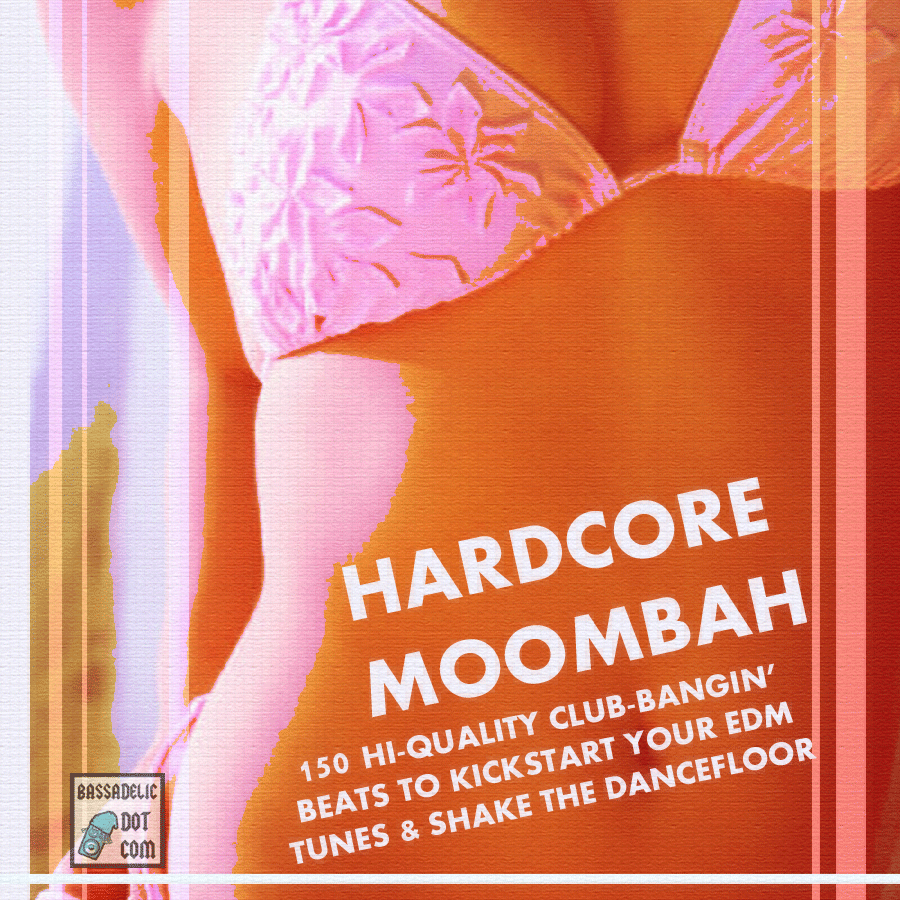

They’re here. Hardcore moombah beats – one hundred and fifty of them, and they’re ready to be used in any DAW that accepts .WAV format audio samples! Yesss!!!!
-
Only for $6 USD !
This package is 25% off the regular price of 20 bucks, because it’s new and I’m doing a promotional offer of just $14.99 :)
you can get it here!
I probably won’t make as much money as some of the bigger name sample stores charging that little for as many samples as there are in this pack, but that’s alright. I say fifteen dollars is a decent price.
This sample pack contains:
-> 75 beats @ 110 bpm
-> 75 beats @ 130 bpm
Moombah has been killing the dancefloors lately, and can be heard in musical styles ranging from hip hop to dubstep, and beyond.
With this new and original sample pack, you are given the chance to explore these sounds further, as these beats help any producer looking to make moombah or moombahcore tunes. Some of the beats in this package have the strength and intensity of hard techno and gabber, while some of them have the agility and quick-pacing of juke or hip hop – and some of them just maintain the classic
moombah and moombahcore style, with that pounding pulse that has been taking the world by storm for the last couple of years!
These instrumental beats are sure to help you with your future edm productions. They are organized into two categories: 110 bpm, and 130 bpm. This is to give you a range of possibilities for making moombah and moombahcore-based tracks. This package was designed to do one thing, and one thing only: to give musicians and producers access to 150 high-quality beats, immediately.
These beats can help with drumming up musical inspiration (yes, a drum pun. sorry) or, you can sample these directly into your beats. Whatever you want!
I really hope you enjoy these beats! I had a lot of fun making them. Moombah and moombahcore beats are extremely fun to work with!
These beats are in WAV format, and so they’re compatible with most music programs, such Propellerhead Reason, Ableton Live, Acid Pro, etc…
-StrangeFlow

So, I found this AMAZING post recently, and felt I had to share it.
TONS of free samples, cut from jungle records from 1989 through 1999 (pretty much the bulk of the jungle years, IMO) and when I say ‘jungle records,’ I mean it – no MP3’s were used for these samples. Blu Mar Ten put them together, and the release is called ‘JungleJungle.’
Here’s what they said, from their website:
_________________
“This pack is made up of samples taken from tracks in our record collection. It started as a bit of fun to kill time in between proper music work and suddenly became quite large, so it seemed a shame not to share it.
These are not some secret special sounds only available to ‘jungle legends’. Anyone with the tracks and some time to waste could have made this pack.
• Size – 390mb
• Contents – 650+ breaks, basses, pads, riffs, hits, vocals & FX
• Format – All samples taken from vinyl or CD and saved as 16bit WAVs.
• No mp3s were involved at any point in the process.
• All samples are cropped & normalized.
• The earliest sample in the pack is from 1989 and the latest is from 1999.
• This pack was created for fun and is not to be sold. All rights remain with the original creators of the samples. If you use these samples for commercial purposes you need to seek the appropriate clearance.
“If you’re not already familiar with how drum & bass came into being we encourage you to go back in time and explore the history. There’s some amazing music waiting for you there.”
_________________
So…are they public domain? Copyright free? There’s a question! They just said in their post that these are not cleared for your usage, so that pretty much sums it up, eh? Here’s the thing: many of these samples (cut from jungle records) are samples cut from older records. So they’re samples of samples. (kinda skwunc, eh?) Does that mean they’re cleared? For you? No. But I say it’s ‘not simplistic’ simply because many of these samples would not have to be cleared by the jungle producers, as, in many cases, they didn’t create them – many of them would have to be cleared by unidentified artists from the 60s, 70s, and 80s…. So, as far as copyright, you need to do your own research on that, as I can not help you with all of these samples, and the two guys who cut these samples say they don’t want to bother with identifying the originals, either. So, just thought I would mention all of this. They’re still fun samples to play around with. So, have fun!
Go here:
Whats up everyone?
So here’s what happened. My laptop I had been using (fat too often?) finally died.
I was working at the time, and everything froze on me, so after waiting awhile, I restarted the thing. That didn’t prove helpful, as it froze, yet again, so I restarted it once more. This time, it wouldn’t come back on. I tried to do all I ccould, over and over, nut nothing worked, so I finally decided to get it fixed at the store…
Well, aside from telling me that it’s probably one of the worst and most-messed-up hard drives they’d ever seen, I decided it was probably time to get a new machine, anyway. I’d been contmplating it for months, and now that my old one is fucked, what a perfect opoporutnity, eh?
So I got a new laptop a couple days ago, and am only going to be able to get a partial amount of files from the old laptop.
But, I’ve been working insanely hard recently to get things back together and work on some new stuff. Now that I have a new machine, I have the ability to work about twice as fast as before, so I’ve been grinding. Fuckin grinding.
I’m going to be releasing a moombah beats pack – WAY bigger than the 20-sample demo I put out a couple months ago. Im still waiting to see if I can get the wonky downtempo breaks off my old computer (had about 70 AWESOME beats on there) as well as a big juke samples pack I was doing (also about 70 files) and also, I’m going to be working on several other packages – and of course, I’m going to be putting up some new reviews and articles, as well!
So, please stay tuned. I’m going to be working as hard as possible to bring new things to the site as fast I can, while still maintining the high quality output that Bassadelic fans have come to love and expect!
Thanks for your patience in BEARING with us, everyone!!!
– Will









 Bassadelic.com :: #1 samples source online! We help electronic / hip hop producers with sounds, resources, tutz, theory, interviews & more!